 centre to
circumference
centre to
circumference§ 6 Fifth Edition
The unprejudiced observer - well aware of the futility of transcendental speculations which can receive no confirmation from experience - be his powers of penetration ever so great, takes note of nothing in every individual disease, except the changes in the health of the body and of the mind (morbid phenomena, accidents, symptoms) which can be perceived externally by means of the senses; that is to say, he notices only the deviations from the former healthy state of the now diseased individual, which are felt by the patient himself, remarked by those around him and observed by the physician. All these perceptible signs represent the disease in its whole extent, that is, together they form the true and only conceivable portrait of the disease.1
1 I know not, therefore, how it was possible for physicians at the sick-bed to allow themselves to suppose that, without most carefully attending to the symptoms and being guided by them in the treatment, they ought to seek and could discover, only in the hidden and unknown interior, what there was to be cured in the disease, arrogantly and ludicrously pretending that they could, without paying much attention to the symptoms, discover the alteration that had occurred in the invisible interior, and set it to rights with (unknown!) medicines, and that such a procedure as this could alone be called radical and rational treatment.
Is not, then, that which is cognizable by the senses in diseases through the phenomena it displays, the disease itself in the eyes of the physician, since he never can see the spiritual being that produces the disease, the vital force? nor is it necessary that he should see it, but only that he should ascertain its morbid actions, in order that he may thereby be enabled to cure the disease. What else will the old school search for in the hidden interior of the organism, as a prima causa morbi, whilst they reject as an object of cure and contemptuously despise the sensible and manifest representation of the disease, the symptoms, that so plainly address themselves to us? What else do they wish to cure in disease but these?*
* The physician whose researches are directed towards the hidden relations in the interior of the organism, may daily err; but the homœopathist who grasps with requisite carefulness the whole group of symptoms, possesses a sure guide; and if he succeed in removing the whole group of symptoms he has likewise most assuredly destroyed the internal, hidden cause of the disease.
§ 6 Sixth Edition
The unprejudiced observer - well aware of the futility of transcendental speculations which can receive no confirmation from experience - be his powers of penetration ever so great, takes note of nothing in every individual disease, except the changes in the health of the body and of the mind (morbid phenomena, accidents, symptoms) which can be perceived externally by means of the senses; that is to say, he notices only the deviations from the former healthy state of the now diseased individual, which are felt by the patient himself, remarked by those around him and observed by the physician. All these perceptible signs represent the disease in its whole extent, that is, together they form the true and only conceivable portrait of the disease.1
1 I know not, therefore, how it was possible for physicians at the sick-bed to allow themselves to suppose that, without most carefully attending to the symptoms and being guided by them in the treatment, they ought to seek and could discover, only in the hidden and unknown interior, what there was to be cured in the disease, arrogantly and ludicrously pretending that they could, without paying much attention to the symptoms, discover the alteration that had occurred in the invisible interior, and set it to rights with (unknown!) medicines, and that such a procedure as this could alone be called radical and rational treatment.
Is not, then, that which is cognizable by the senses in diseases through the phenomena it displays, the disease itself in the eyes of the physician, since he never can see the spiritual being that produces the disease, the vital force? nor is it necessary that he should see it, but only that he should ascertain its morbid actions, in order that he may thereby be enabled to cure the disease. What else will the old school search for in the hidden interior of the organism, as a prima causa morbi, whilst they reject as an object of cure and contemptuously despise the sensible and manifest representation of the disease, the symptoms, that so plainly address themselves to us? What else do they wish to cure in disease but these?
COMMENTARY:
Hahnemann begins this aphorism by the word " The unprejudiced observer". Every body is prejudiced. One is prejudiced in politics, another in religion, another in medical field. You need to only talk to a a politician a moment on his subject he will tell you what he thinks; he will give you his reason, as if he has anything to do with it. They are prejudiced because there is no laws and principles. There is no law because they have no authority.
In homoeopathy the laws and principles must be accepted as authority.
Allopathic physician is best example of prejudiced observer (and also Homoeopathic physician who do not follow the laws and principles). Allopathic physician may say for example - I have discovered your disease now after thorough investigation that your heart burn is due to chronic duodenal ulcer, and to another suffering from stomatitis is due to aplastic anemia and your fever is due to acute inflammation of bronchial tree( acute bronchitis) and they add more fancy theories to each of the disease. That fever is caused by bacteria another to viruses etc.
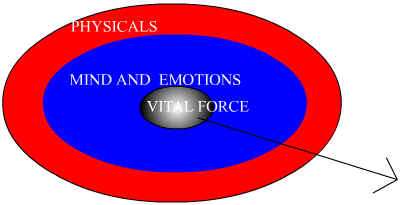
Now back to homoeopathy. No organ can make another sick. Man is prior to his organ. When we realize that the course of things is from centre to circumference we must admit that heart burn is caused from the centre, chronic duodenal ulcer also from centre, stomatitis is also from centre, anemia is also from centre, fever is also from centre, acute inflammation of bronchial tree is also from centre, but not made each other sick. The centre has been named as vital force which will dealt in detail later
LOOK AT THE PICTURE HOW THE CENTRE CALLED VITAL FORCE MANAGES THE MIND AND BODY IN HEALTH.
Every thing is managed by the centre-both mind and physical body. When in health mind (including emotions) and body (physical) is harmonious
WHEN IN HEALTH
centre to
circumference