Therefore disease (that does not come within the province of manual surgery) considered, as it is by the allopathists, as a thing separate from the living whole, from the organism and its animating vital force, and hidden in the interior, be it ever so subtle a character, is an absurdity, that could only be imagined by minds of a materialistic stamp, and has for thousands of years given to the prevailing system of medicine all those pernicious impulses that have made it a truly mischievous [non-healing] art.
commentary:
Hahnemann wishes to teach that it is a disorder of the activities of the internal man, a lack of harmony or lack of balance, which gives forth the signs and symptoms by which we recognize disease. These sensations comprise the language of disorder ; i.e., the aid by which we recognize disease.
This immaterial vital principle, permeates the organism, and in disease this disorder everywhere permeates the organism, it permeates every cell and every portion of the human economy.
We will see that the change in form of a cell (pathology) is the result or product of disorder. The derangement of the immaterial vital principle is the very beginning of the disorder, and that with this beginning there are changes in sensation by which man may know this beginning, which occurs long before there is any visible change in the material substance (pathology) of the body.
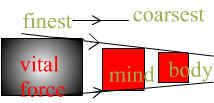
It has its association, from the finest (vital force) forms of physical substance to the coarsest (the physical body), from beginning to end, from the inner to the outer. Such changes and activities as result in the very coarsest forms are but the results of disease through a series of degrees, coarser and coarser to the outermost man.
Everything that can be seen (body changes or pathology), that can be observed with the aid of the finest instrument (laboratory findings, scanning), is but the result. The finer things, which is the vital force cannot be seen by any of the instrument. Nothing in the world of immaterial substance can be seen with any faculty that is capable of seeing things in the world of material substance.
The utilization of instruments of precision will enable us to see the finest disease results (pathology), which are the outcome or results of things immaterial. The virus for instance, the very finest form of animal or vegetable life ; but the cause of disease is a million times more subtle than these and cannot be seen by the human eye.
The finest visible objects are but results of things still finer, so that the cause rests within (vital force).
The morbific agents that Hahnemann refers to are simply the extremely fine forms of simple substance, or to bring them down to human thought we might call them viruses ; but viruses are often gross because they can be observed by the instrument.
The coarser forms would be comparatively harmless but not for their interiors. Disease products are comparatively harmless were it not for the fact that they contain an innermost and it is the innermost itself that is causative.
Graphic representation of disease formation from the centre
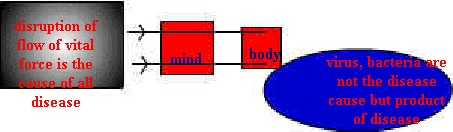
The bacteria are the result of conditions within. If there were no agitating influence in the interiors of man he never would have symptoms. As you sit there in your seats in a perfect state of serenity you are not conscious of your ear, face, eyes nose etc. You have to stop and think whether you feel or not. When all the functions are carried on in a perfectly orderly way you have no consciousness of your body, which means that you are in freedom.
Disease is not freedom
When not in freedom the individual says : "I feel." It is this disruption of an invisible character which comes from cause, and appears by changes in the activities of the body, changes in sensations, changes in functions.
It is in only in accordance with these sensations the physician shall be intelligent enough to read them and know what they mean. They are a warning, they are for us, for purpose.