
ANTIPATHY AND HOMOEOPATHY
ANTIPATHY
Antipathic treatment- modus operandi
Here the medicinal symptoms with which physician opposes to the disease symptom (for example, the insensibility and stupefaction caused by opium in its primary action to acute pain) is not foreign or not new or not allopathic to the disease in question. There is a manifest relation between medicine symptom and disease symptom because medicine touches the same area (body part) or part of the disease. Such an antagonistic medicine does not cure the disease. Since the medicine is opposite in nature to the disease it (medicine) makes the disease unobservable for a short time so that in the first period of action of the antagonistic palliative medicine, the vital force perceives nothing disagreeable from either of the two (neither from the disease symptom nor from the medicinal symptom), as they both seem to have mutually removed and dynamically neutralized one another as it were (for example, the stupefying power of opium does this to the pain). Consequently the vital force feels quite well, (and perceives neither the stupefaction of the opium nor the pain of the disease). But the antagonistic medicinal symptom cannot (as in the homœopathic treatment) occupy the place of the morbid derangement present in the organism so as to be able to step into the place of the original natural morbid derangement, the palliative medicine must, as a thing totally differing from, and the opposite of the disease derangement, leave the disease uneradicated; it renders it, as before said, by a semblance of dynamic neutralization,1at first unfelt by the vital force, but, like every medicinal disease, it is soon spontaneously extinguished, and not only leaves the disease behind, just as it was, but compels the vital force as it must be given , like all palliatives, in large doses in order to effect the apparent removal to produce an opposite condition (§§ 63,64) to this palliative medicine, the reverse of the medicinal action, consequently the analogue of the still present, undestroyed, natural morbid derangement, which is necessarily strengthened and increased by this addition (reaction against the palliative) produced by the vital force. The disease symptom (this single part of the disease) consequently becomes worse after the term of the action of the palliative has expired; worse in proportion to the magnitude of the dose of the palliative. Accordingly (to keep to the same example) the larger the dose of opium given to allay the pain, so much the more does the pain increase beyond its original intensity as soon as the opium has exhausted its action.
HOMOEOPATHIC TREATMENT-modus operandi
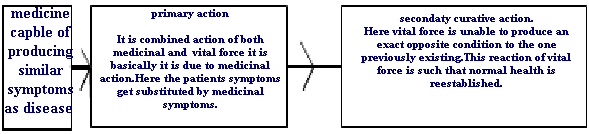
Homœopathic medicine chosen based on account of the similar affection it produces on healthy individual. Here homoeopathic medicinal symptoms occupy the place of morbid derangement present in the organism as a similar, stronger artificial disease (drug disease), and step into the place of original natural derangement. A small dose of dose every one of the homoeopathic medicine produces a primary action that is perceptible to a sufficiently attentive observer. But living organism employs against this primary action only so much reaction as is necessary for the restoration of the normal condition.